
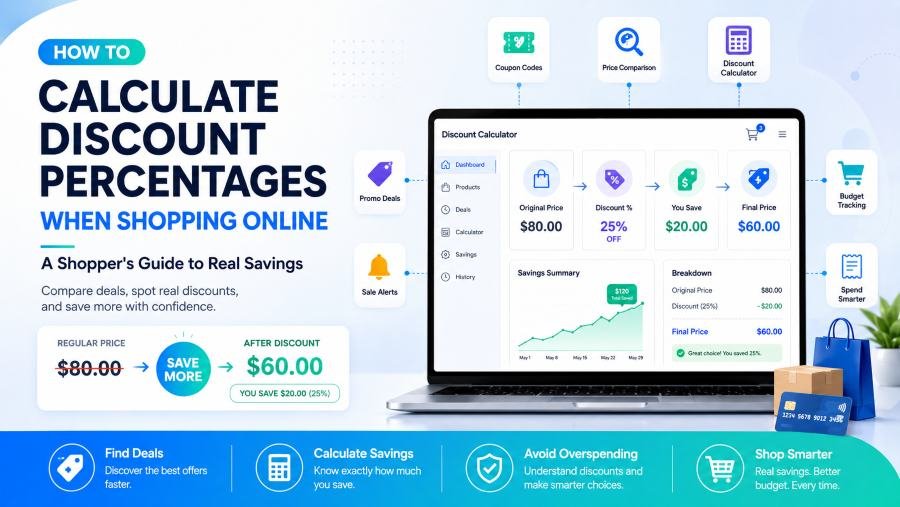
Online shopping is flooded with discounts. "50% OFF," "Flash Sale," "Limited Time Only" — these banners trigger impulse buys before your brain has time to evaluate whether the deal is genuine. In 2024, over 80% of ecommerce emails from major brands included some form of discount, making psychological pricing tactics the norm rather than the exception. The problem is not calculating the math. The problem is knowing when the math actually matters.
This guide teaches you how to calculate discount percentages when shopping online, but more importantly, it shows you how to spot fake discounts, compare stacked offers, and use free online tools to verify that your "savings" are real. Whether you are buying a $50 gadget or a $500 appliance, the same principles apply: calculate correctly, compare honestly, and never let a percentage sign override your judgment.
The Three Formulas Every Online Shopper Needs
Discount math is simple, but three different situations require three different approaches. Memorize these and you will never overpay again.
Formula 1: Calculate Final Price From a Percentage Discount
This is the most common scenario. You see an original price and a discount percentage. You need the final price.
Step 1: Convert the percentage to a decimal. 20% becomes 0.20. Step 2: Multiply the original price by the decimal. This gives you the discount amount. Step 3: Subtract the discount amount from the original price.
Example: A jacket costs $120 with 25% off.
-
Discount amount: $120 × 0.25 = $30
-
Final price: $120 − $30 = $90
Shortcut: Multiply the original price by (1 − discount decimal). For 25% off, multiply by 0.75. $120 × 0.75 = $90 instantly.
Formula 2: Calculate the Discount Percentage From Two Prices
You see a sale price and an original price, but the discount percentage is not shown. You need to verify whether the claimed discount is accurate.
Step 1: Subtract the sale price from the original price. This gives the discount amount. Step 2: Divide the discount amount by the original price. Step 3: Multiply by 100.
Example: An item was $100, now $75.
-
Discount amount: $100 − $75 = $25
-
Discount percentage: ($25 ÷ $100) × 100 = 25%
This formula is your weapon against fake discounts. If a retailer claims "40% off" but your calculation shows 15%, you know the anchor price was inflated.
Formula 3: Calculate the Original Price From a Discounted Price
You see a final price and a discount percentage, and you want to know what the item originally cost. This is essential for verifying whether a "discount" is real or manufactured.
Step 1: Convert the discount percentage to a decimal. Step 2: Subtract that decimal from 1. Step 3: Divide the final price by the result.
Example: A supplier invoices you $150 for an item described as "already discounted by 25%."
-
1 − 0.25 = 0.75
-
Original price: $150 ÷ 0.75 = $200
The item was originally $200. You saved $50. If the retailer claims the original price was $300, the discount is fake.
How Retailers Manipulate Discount Percentages: The Psychology You Are Up Against
Retailers do not just calculate discounts — they engineer them. Understanding these tactics is as important as knowing the formulas.
Anchor Pricing: The Fake Original Price
The most common manipulation is displaying a high "original" price that the item never actually sold for. Your brain anchors to that first number, making the sale price feel like a victory even if it is the normal market rate.
Example: A smartwatch usually sells for $149. Before Black Friday, the retailer raises it to $199, then slashes it to $119 with a "40% off" banner. The actual discount from the real market price is only 20%, but the anchor makes it feel like 40%.
How to fight it: Use price history tools to check whether the item was ever sold at the claimed original price. If the "was" price only existed for two weeks before the sale, it is a fabricated anchor.
Inflated Prices Before Sales
Some retailers quietly raise prices right before a promotional period, then drop them back to normal and call it a sale. The discount percentage is calculated from an artificially inflated baseline.
How to fight it: Track prices for 30 days before major sales events. If the price jumps 30% two weeks before Black Friday, the "40% off" sale is actually a 10% discount from the true price.
Charm Pricing and Perception Manipulation
$49.99 feels cheaper than $50 because your brain anchors on the first digit. Retailers use this to make discounts feel larger than they are. A $49.99 item marked down from $79.99 feels like a $30 saving, but it is only $0.01 more than a $50-to-$20 reduction.
How to fight it: Round prices mentally before calculating. $49.99 is $50. $79.99 is $80. The real saving is $30, not $30.01, and the percentage is 37.5%, not the 38% your brain might register.
Scarcity and Urgency Tricks
"Only 3 left in stock!" and "Deal ends in 2 hours!" trigger loss aversion — the psychological pain of missing out feels worse than the pleasure of saving. These cues are often manufactured. Inventory counters reset, and countdown timers restart daily.
How to fight it: If a deal is truly good, it will likely reappear. Wait 24 hours. If the urgency was real, the price will change. If it was fake, the same "limited" offer will still be there.
Stacked Discounts: When 20% + 10% Does Not Equal 30%
Stacked or sequential discounts apply one after another, not additively. The second discount applies to the already-reduced price, not the original.
Example: A $100 item with 20% off, then an additional 10% off.
-
After 20%: $100 × 0.80 = $80
-
After 10%: $80 × 0.90 = $72
-
Total saved: $28
-
Effective discount: 28%, not 30%
Retailers often advertise "up to 30% off with stacked discounts" knowing shoppers will mentally add the percentages. The actual savings are always less.
How to fight it: Calculate sequentially. Never add percentages. Use the shortcut: final price = original price × (1 − first discount) × (1 − second discount).
Bundling Illusions
"Buy a laptop, get a case free!" sounds like a $50 saving. But if the laptop is $50 more expensive than the same model elsewhere, you paid for the case.
How to fight it: Calculate the total cost of the bundle and compare it to buying the items separately from different retailers. The "free" item is rarely free.
Fixed Amount vs. Percentage Discount: Which Saves More?
Not all discounts are structured the same way. A $20 coupon and a 20% off sale produce different results depending on the price.
Table
| Original Price | 20% Off | $20 Off | Better Deal |
|---|---|---|---|
| $50 | $10 saved | $20 saved | Fixed amount |
| $100 | $20 saved | $20 saved | Equal |
| $200 | $40 saved | $20 saved | Percentage |
| $500 | $100 saved | $20 saved | Percentage |
Rule of thumb: For items under $100, fixed amount discounts usually save more. For items over $100, percentage discounts scale better. Always calculate both before celebrating a "deal."
How to Spot a Fake Discount in 60 Seconds
Fake discounts are so common that consumer protection agencies have issued guidelines. In the EU and UK, reference prices used in discount claims must be the lowest price charged in the preceding 30 days. In Australia, the ACCC requires that any "was" price must be a genuine price the item was actually sold at. Here is how to verify a discount before you buy.
Step 1: Check Price History
Use price tracking tools to see if the item was sold at the claimed original price recently. If the "was $200" price only existed for three days before the sale, it is a fake anchor.
Step 2: Compare Across Retailers
One store's "deal" may be another store's normal price. Search the product on Google Shopping, Amazon, and comparison sites. If three retailers sell it at the "discounted" price without a sale banner, the discount is fiction.
Step 3: Calculate the Percentage Yourself
Do not trust the retailer's claimed percentage. Use Formula 2: (original − sale) ÷ original × 100. If your calculation does not match the banner, the original price was inflated.
Step 4: Watch for Permanent Sales
Items listed as "on sale" indefinitely are not on sale. The "sale" price is the real price. The retailer uses a permanent discount banner to trigger your loss aversion reflex.
Step 5: Beware of Reference Discounts
"Our price: $79.99 — Competitor's price: $129.99" is a common tactic. The competitor price may be outdated, inflated, or from a different region. Verify the competitor price independently.
Using Free Online Tools to Calculate and Verify Discounts
Manual calculation works for simple cases, but online shopping involves tax, shipping, multiple items, and stacked coupons. Free online utilities automate the math and reduce error.
Toolversal Discount Calculator
Toolversal's Percentage Calculator handles the three core formulas instantly. Enter any two values — original price, discount percentage, or final price — and it calculates the third. It also handles reverse percentage calculations, which is useful when you need to find the original price from a discounted one.
Features:
-
Instant calculation of discount amount, final price, and savings percentage.
-
Reverse calculation to expose fake original prices.
-
Comma-separated formatting for easy copy-paste into spreadsheets.
-
Client-side processing — your shopping data never leaves your browser.
Workflow: Paste the original price → enter the discount percentage → see final price, amount saved, and effective percentage. If the numbers do not match the retailer's claims, you have caught a manipulation.
When to Use a Calculator vs. Mental Math
| Scenario | Best Method | Why |
|---|---|---|
| Single item, round numbers | Mental math | Faster than opening a tool |
| Multiple items with different discounts | Online calculator | Prevents cumulative errors |
| Stacked discounts (20% + 10%) | Online calculator | Sequential math is error-prone |
| Verifying a claimed discount | Online calculator | Precision matters for comparison |
| Tax-included final prices | Online calculator | Handles decimal precision |
Tax, Shipping, and Hidden Costs: The Real Final Price
A discount percentage means nothing if tax and shipping erase the savings. Smart shoppers calculate the total cost, not just the discounted item price.
Tax Is Calculated After Discount
In most jurisdictions, sales tax applies to the price after the discount, not the original price. If a $300 item is 20% off, tax applies to $240, not $300. Some retailers incorrectly display tax on the original price to make the final cost seem higher than it is.
How to verify: Check your cart summary. The tax line should show a percentage of the discounted subtotal, not the original subtotal.
Shipping Thresholds Change the Math
A $50 item with 20% off saves you $10. But if shipping costs $12 and the free shipping threshold is $75, your total cost is $52 — only $8 less than the original price with free shipping. The discount is effectively 16%, not 20%.
How to calculate: Add the item to your cart, proceed to checkout, and note the final total including tax and shipping. Compare this total across retailers, not just the item price.
Membership Discounts vs. One-Time Coupons
A 10% membership discount that costs $50 per year requires $500 in annual purchases to break even. A one-time 15% coupon on a $200 purchase saves $30 immediately. The membership only wins if you shop frequently.
How to calculate: Divide the membership cost by the discount percentage to find the break-even spend. $50 ÷ 0.10 = $500. If you spend less than $500 annually, the membership loses money.
Advanced Scenarios: When Discount Math Gets Tricky
Bulk and Quantity Discounts
"Buy 10, get 10% off" sounds straightforward, but tiered pricing requires per-unit math.
Example: A product costs $20 per unit. The tier is 10–49 units at 10% off, 50+ units at 20% off.
-
10 units: $200 × 0.90 = $180 total, $18 per unit.
-
50 units: $1,000 × 0.80 = $800 total, $16 per unit.
Buying 50 units saves $400 versus buying 10 units five times. But do you need 50 units? The discount only saves money if you would have bought the quantity anyway.
Settlement and Early Payment Discounts
Some suppliers offer 2/10 net 30 terms: 2% discount if paid within 10 days, otherwise full price in 30 days. This is a 2% discount for paying 20 days early.
Annualized return: (2% ÷ 98%) × (365 ÷ 20) = 37.2% annualized. Taking this discount is almost always better than keeping the cash in a savings account earning 4%.
Trade Discounts
Suppliers offer trade discounts to distributors before the invoice is raised. The discount never appears as a line item — the invoice is simply issued at the net amount. If you are a reseller, knowing the trade discount percentage helps you calculate your true cost and margin.
Key takeaway: Advanced discount scenarios — bulk pricing, settlement terms, and trade discounts — require context beyond simple percentage math. Calculate per-unit costs, annualized returns, and true margins before committing.
Building a Smart Shopping Workflow
Efficient shoppers do not calculate discounts one by one. They build a workflow that automates comparison and verification.
Step 1: Track Prices Before You Need to Buy
Use price alerts for items you plan to purchase. When the price drops, you receive a notification with the actual discount percentage calculated from the historical average, not the retailer's claimed anchor.
Step 2: Calculate Total Cost Before Checkout
Add the item to your cart, enter your shipping address, and note the final total. Use Toolversal's Percentage Calculator to compute the effective discount from this total, not the item price.
Step 3: Verify the Discount Independently
Search the product on three other retailers. If the "discounted" price is the normal price elsewhere, the discount is fake. Use Formula 2 to calculate the real percentage from the lowest verified original price.
Step 4: Wait 24 Hours for Urgency Decisions
If a deal is truly limited, the price will change. If it is manufactured urgency, the same offer will still be there tomorrow. Most impulse purchases are avoided with a single night of sleep.
Step 5: Document Your Savings
Keep a spreadsheet of purchases, claimed discounts, and actual savings. Over time, you will spot patterns — which retailers inflate prices, which offer genuine discounts, and which manipulate percentages.
Final Thoughts: The Real Math Is Not the Percentage
Calculating discount percentages is easy. The hard part is knowing when to trust the number in front of you. Retailers have spent decades refining the psychology of discounts — anchor pricing, fake urgency, stacked confusion, and charm pricing are designed to bypass your rational brain and trigger your emotional one.
The shopper who wins is not the one who calculates fastest. It is the one who calculates correctly, compares honestly, and refuses to let a red percentage sign override their judgment. A 50% discount on something you do not need is a 100% waste of money. A 10% discount on something you would buy anyway is a genuine saving.
If you want to shop smarter, start with the right tools. Use Toolversal's free online calculators to verify discount percentages, compare total costs, and expose fake anchors before you check out. The math takes 10 seconds. The savings last forever.